
In today's fast-paced business environment, managing employee attendance efficiently is crucial for small businesses aiming to boost productivity, ensure accurate payroll processing, and maintain high levels of security. Traditional methods like manual registers, punch cards, or even passcodes and patterns are prone to errors, proxy registration, and time theft, leading to financial losses and administrative burdens. This is where biometric attendance devices come into play, revolutionizing workforce management with advanced identity authentication technologies.
Biometric systems use unique physiological traits, such as fingerprints, facial detection, iris recognition, vocal patterns, or hand metrics, to provide tamper-proof attendance tracking. These biometric attendance machines eliminate malpractices like buddy punching, offer precise data on arrival times and departure times, and integrate seamlessly with payroll software for overtime calculation, shift management, and monthly attendance reporting. For small businesses, investing in a reliable biometric attendance device means improved employee monitoring, time efficiency, and overall productivity improvement.
Why Small Businesses Need Biometric Attendance Systems in 2026
Small offices and mid-sized organizations often operate with limited resources, making manual conventional attendance methods inefficient. Biometric readers provide data security through breach prevention and encrypted storage, ensuring compliance with labor laws. Key benefits include:
-
Security and Malpractice Prevention: Unique biometrics prevent proxy entries.
-
Contactless Operation: Especially with face recognition and facial detection, promoting hygiene in high-traffic areas.
-
Speed and Convenience: Quick recognition time (often under 1 second) with anti-spoofing features like 3D recognition or infrared for masks and varying lighting conditions.
-
Scalability: Suitable for growing teams, with user capacities from hundreds to thousands.
-
Integration Capabilities: Many support HR attendance sync, payroll software integration, and cloud management via Wi-Fi, LAN, or Bluetooth.
-
Cost-Effectiveness: Reduced upfront cost for small setups, with low maintenance expenses and ROI through time theft reduction.
When choosing a biometric attendance machine, consider factors like the number of employees, environment (indoor/outdoor with dust or weather resistance), smart features, and connectivity options. For small businesses, hybrid solutions combining fingerprint and face recognition often strike the best balance between accuracy, reliability, and budget.
Face vs Fingerprint: Facial systems offer contactless identification and handle issues like dirty or worn fingerprints, while fingerprints remain durable in dusty environments.
In 2026, trends lean toward AI-powered face recognition solutions with cloud-based attendance for remote accessibility, multi-site management, and auto-updates. These systems support distributed workforces with features like geo-tagging and mobile clocking.
Now, let's dive into our curated list of the top 7 biometric attendance machines ideal for small businesses in 2026. Each entry includes real pros and cons based on user feedback and performance data.
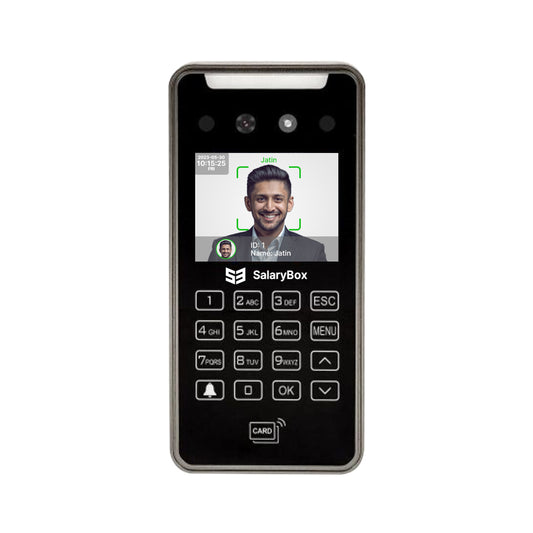
1. SalaryBox Gama
The SalaryBox Gama stands out as a cutting-edge biometric attendance device tailored for small businesses seeking seamless integration and advanced features. This AI-driven machine uses facial recognition with liveness detection, supporting hybrid modes for ultimate flexibility.
Pros:
-
Lightning-fast verification under 1 second, even with masks, ensuring speed and convenience in busy small offices.
-
Seamless payroll software integration and cloud connectivity for real-time entries, overtime calculation, and monthly reports, perfect for accurate payroll without manual intervention.
-
High user capacity (1,000+ faces) with excellent scalability as your business grows.
-
Built-in Wi-Fi and mobile app support for remote monitoring and employee activity tracking.
-
Robust data security with encryption, preventing breaches and ensuring compliance.
Cons:
-
Designed for growing teams, so it provides more advanced features than basic needs, allowing room for future expansion without immediate upgrades.
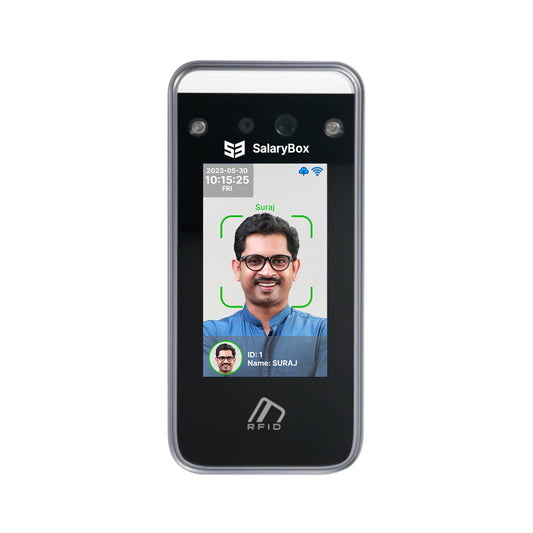
2. SalaryBox FaceScan Pro
Building on the Gama's success, the SalaryBox FaceScan Pro is a premium face recognition attendance machine with access control capabilities, making it ideal for small businesses prioritizing hygiene and security.
Pros:
-
Advanced AI for 99%+ accuracy in facial detection, with anti-spoofing and support for varying lighting conditions.
-
Contactless operation promotes hygiene in high-traffic areas, combined with RFID for backup.
-
Direct HR/payroll integration for effortless shift management and real-time alerts.
-
Inbuilt Wi-Fi, USB, and LAN for flexible connectivity options and easy installation.
-
Vibrant HD display and spacious interface for user-friendly attendance marking.
Cons:
-
Its professional-grade features make it a future-proof investment, encouraging businesses to leverage full capabilities over time.
3. ZKTeco MB360
ZKTeco is a global leader in biometric systems, and the MB360 offers multi-modal authentication (face, fingerprint, RFID) in a compact design suitable for small offices.
Pros:
-
Versatile with 1,500 faces and 3,000 fingerprints capacity, plus Wi-Fi for cloud syncing.
-
Fast recognition and basic payroll integration via SDK.
-
Affordable entry-level pricing with reliable performance.
-
Anti-spoofing algorithms for enhanced security.
Cons:
-
Limited advanced cloud features compared to dedicated payroll-integrated systems.
-
Basic mobile apps may require additional setup for full remote access.
4. eSSL K30 Pro
A popular choice in India, the eSSL K30 Pro is a robust fingerprint recognition device with push data technology, great for small businesses needing simple yet effective tracking.
Pros:
-
Handles 1,000-2,000 users with quick scans and access control options.
-
Push data for real-time syncing and Excel exports.
-
Budget-friendly with battery backup for power fluctuations.
-
Easy installation and low maintenance.
Cons:
-
Primarily fingerprint-based, so less ideal for contactless preferences.
-
Interface can feel dated; limited native cloud depth without add-ons.
5. Mantra MFSTAB Series
Mantra's MFSTAB devices focus on reliable fingerprint and multi-biometric options, often Aadhaar-enabled for compliance-heavy small businesses.
Pros:
-
High accuracy with scratch-resistant sensors and large storage.
-
Supports ERP/HRMS integration for payroll.
-
Portable and rugged for varied environments.
-
Cost-effective with good local support.
Cons:
-
More geared toward government compliance; may require extra configuration for pure private small business use.
-
Limited facial options in base models.
6. Realtime RS Series (e.g., RS9n or T60)
Realtime offers industrial-grade biometric attendance machines like the RS series, known for durability in small manufacturing or office setups.
Pros:
-
Strong fingerprint and optional face modes with TCP/IP connectivity.
-
Affordable and easy to deploy for basic attendance tracking.
-
Good for dusty environments with reliable sensors.
-
Integrates with third-party payroll.
Cons:
-
Offline-heavy cloud features may need extra modules.
-
Slower recognition in high-volume scenarios compared to AI-focused devices.
7. Biomax N-BM70W Pro
The Biomax series provides Wi-Fi-enabled face biometric machines, suitable for modern small offices embracing contactless tech.
Pros:
-
Versatile face and fingerprint with Wi-Fi for cloud management.
-
Access control integration and temperature options (post-pandemic relevance).
-
User-friendly with good capacity for small teams.
-
Competitive pricing with push data.
Cons:
-
May struggle in extreme lighting without advanced infrared.
-
Integration depth varies; best for basic payroll syncing.
Final Thoughts
Choosing the right biometric attendance device in 2026 depends on your small business's specific needs, whether prioritizing contactless facial identification, seamless payroll integration, or budget-friendly durability. Devices like the SalaryBox Gama and FaceScan Pro lead with innovative AI, cloud solutions, and direct HR sync, making them top picks for efficiency and growth.
Investing in these systems not only prevents time theft but also enhances workforce management, data integrity, and overall security. For small businesses, the shift to biometrics is a smart business investment yielding quick ROI.
FAQs
1. What is the best biometric attendance machine for small businesses with payroll integration?
The SalaryBox Gama or FaceScan Pro excels here, offering seamless sync with payroll software for automatic overtime calculation and accurate monthly processing. Examples from users show reduced payroll errors by up to 90%, making it a preferred choice over basic devices.
2. Are facial recognition systems better than fingerprints for small offices?
Yes, especially for hygiene and speed. Devices like SalaryBox FaceScan Pro provide contactless operation with high accuracy, handling masks and lighting variations better than traditional fingerprints.
3. How secure are biometric attendance devices?
Highly secure with encryption, anti-spoofing, and unique biometrics. SalaryBox models, for instance, use hashed data storage and SSL/TLS, ensuring breach prevention and compliance.
4. Can these machines handle remote or hybrid workforces?
Many support cloud and mobile apps. SalaryBox Gamma integrates geo-tagging and mobile clocking, ideal for distributed teams.
5. What if power or the internet fails?
Most have battery backup and offline modes. SalaryBox devices store data locally and sync when connected, ensuring no loss.
6. Is installation complicated for small businesses?
No, most offer easy setup with Wi-Fi/LAN. SalaryBox provides intuitive interfaces and support for quick deployment.
7. Which device is most cost-effective long-term?
Integrated solutions like SalaryBox Gamma save on admin time and errors, offering the best ROI for small businesses through productivity gains and precise payroll.