
In today's fast-paced business environment, effective workforce management is crucial for boosting productivity, ensuring accuracy, and maintaining security. Traditional methods like manual attendance using pen-and-paper registers, punch cards, ID cards, or PINs are prone to errors in manual attendance, fraudulent entries, time theft, buddy punching, and proxy attendance. These issues lead to payroll leakage, inflated labour costs, and reduced employee morale.
Enter the biometric attendance system, a modern solution that uses unique biometric identifiers such as fingerprints, facial scans, iris patterns, or even voice authentication to automate employee time tracking. A biometric time attendance system eliminates human errors, prevents fraud, and provides real-time logging of attendance with precise time stamps. This guide will help you understand everything about biometric attendance machines, from types and benefits to key factors for selection, ensuring you choose the best one for your business.
Why Switch to a Biometric Attendance System?
Outdated systems like manual attendance errors and RFID access control often result in discrepancies that affect payroll processing and overtime tracking. A biometric attendance machine revolutionizes this by offering:
-
Enhanced Accuracy: No more guesswork or disputes over attendance records.
-
Fraud Prevention: Eliminates proxy attendance and buddy punching through unique biological traits.
-
Improved Efficiency: Automates attendance reports, absenteeism tracking, and integration with payroll software or HR systems.
-
Cost and Time Saving: Reduces payroll leakage and administrative overheads.
-
Real-Time Insights: Managers get dashboard analytics, real-time alerts, and data for better workforce planning.
Businesses across sectors, corporate offices, manufacturing industry, healthcare, education, retail, construction, and field services are adopting biometric systems for streamlined workflows, operational efficiency, and transparency.
Understanding Biometric Technology
A biometric attendance system works through two main processes, enrollment (capturing and storing employee data) and authentication (verifying identity during check-in/out).
Types of Biometric Identifiers
-
Fingerprint Recognition: The most common and cost-effective method. It scans unique ridge patterns on fingerprints. Ideal for small to medium businesses but may have issues in dusty environments like construction sites.
-
Facial Recognition: Uses AI in facial recognition to map unique facial features. Offers contactless attendance, making it a hygienic solution post-pandemic. Advanced models include AI-driven liveness detection and anti-spoofing to prevent photo-based fraud.
-
Iris Recognition: Scans iris patterns or iris scans for ultra-high accuracy. Best for high-security environments but more expensive.
-
Palm Vein Authentication or Vein Pattern: Scans subsurface veins—highly secure and contactless.
-
Multi-Modal Biometrics: Combines methods (e.g., fingerprint + facial) for multi-factor authentication and lower false acceptance rate (FAR) or false rejection rate (FRR).
Emerging trends include wearable biometrics, gait analysis, and mobile-based biometrics with geofencing for remote employees or mobile workforce.
Benefits of Biometric Attendance Machines
Implementing a biometric time attendance system brings tangible advantages:
-
Elimination of Proxy Attendance: Ensures accountability and boosts employee morale.
-
Hygiene Compliance: Contactless operations reduce hygiene concerns.
-
Labour Costs Reduction: Accurate overtime rules and absenteeism prediction minimize unnecessary payouts.
-
Enhanced Security: Features like data encryption, liveness detection, and audit trails protect against tampering.
-
Scalability: Suitable for small businesses, startups, or large enterprises with multiple shifts or hybrid teams.
-
Integration Capabilities: Seamless with HR software, payroll integration, leave and attendance management, and shift management.
-
Regulatory Compliance: Helps adhere to labour laws, privacy laws (e.g., GDPR, CCPA, Information Technology Rules 2011 in India), with employee consent and data retention policies.
In the Indian biometrics market, these systems are gaining traction for accurate calculations of wages, especially in the manufacturing and education industry.
Key Features to Look for in a Biometric Attendance Machine
When evaluating options, prioritize:
-
Hardware Specs: High-capacity storage, durable build for construction or field employees.
-
Software Features: Cloud storage, real-time data, customized reporting, analytics.
-
Terminal Types: Wall-mounted, mobile apps, self-service kiosks.
-
Network Requirements: Online systems, offline mode, or hybrid deployments with edge computing.
-
Security Measures: Encryption, anti-tampering, role-based access control.
-
User-Friendliness: Intuitive interface, quick authentication process.
-
Advanced Tech: AI-powered biometric technology, fraud detection, mask detection.
For remote teams or shift workers, look for mobile attendance tracking and geofencing.
Recommended Biometric Machines: Spotlight on SalaryBox Products
In the competitive Indian biometrics market, SalaryBox stands out with affordable, feature-rich devices integrated with their attendance software and payroll software.
-
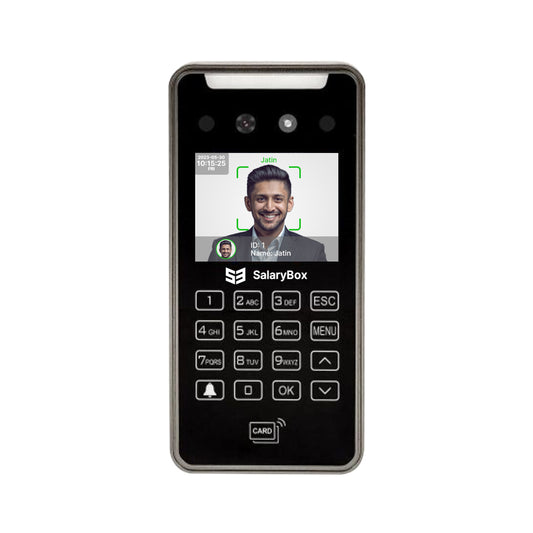
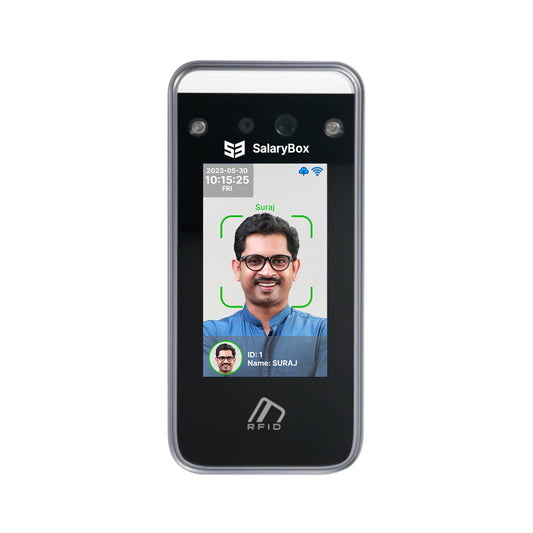
SalaryBox Gamma: A top facial recognition attendance device with AI face recognition, dual cameras (HD color + infrared) for low-light accuracy, mask detection, and liveness detection. Supports up to 5,000 faces, WiFi/LAN connectivity, and seamless cloud sync. Perfect for corporate offices, educational institutions, and healthcare needing touch-free access and hygienic solutions. Priced around ₹12,000–₹15,000, it's cost-effective with excellent return on investment (ROI).
-
SalaryBox FaceScan Pro: A hybrid powerhouse combining fingerprint scanning and facial recognition with AI-driven liveness detection. Rugged design for tough environments like manufacturing or construction sites. Offers high capacity, real-time attendance tracking, and integration with SalaryBox app for mobile attendance. Ideal for businesses wanting multi-modal fusion to minimize false positives or false negatives. Often ranked among the best in 2026 for enhanced accuracy and fraud prevention.
Both integrate effortlessly with SalaryBox's platform for payroll processing, HR integration, and real-time insights.
Factors to Consider When Choosing a Biometric Attendance Machine
Business Size and Needs
-
Small Businesses or Startups: Opt for affordable biometrics like entry-level fingerprint models.
-
Large Enterprises: Choose scalable, cloud vs on-premises with high capacity.
Industry-Specific Requirements
-
Manufacturing/Construction: Rugged, dust-resistant hybrids.
-
Education: Student attendance tracking with facials for schools.
-
Retail/Healthcare: Contactless solutions for hygiene.
Cost Considerations
-
Hardware Costs: Entry-level ₹5,000–₹10,000; Mid-range ₹10,000–₹20,000; High-end ₹20,000+.
-
Total Cost of Ownership (TCO): Include software licensing, implementation costs, maintenance costs (e.g., sensor cleaning, firmware updates).
-
In India, expect good ROI through reduced time fraud and streamlined processes.
Privacy and Compliance
Address privacy concerns with secure databases, data privacy, and consent management. Ensure privacy and compliance with Indian laws.
Vendor Support
Look for reliable manufacturer support, vendor support, and ease of integration.
Implementation and Best Practices
-
Employee Enrollment: Train staff for smooth onboarding.
-
Data Management: Regular backups and audit trails.
-
Maintenance Requirements: Minimal for cloud-based; periodic for hardware.
Future Trends in Biometric Attendance
Look forward to futuristic attendance management with blockchain audit trails, AI integration, cloud computing, and biometric apps for attendance.
FAQs About Biometric Attendance Machines
1. What is a biometric attendance system?
It's a device using biometric authentication like fingerprint scanning or facial recognition for accurate employee attendance tracking.
2. How does facial recognition prevent proxy attendance?
With AI-powered detection of live faces via liveness detection, it rejects photos or videos.
3. Are biometric systems hygienic?
Yes, contactless options like facial recognition address hygiene concerns effectively.
4. What is the cost of biometric machines in India?
Ranges from ₹5,000 for basic to ₹25,000+ for advanced, depending on features.
5. Can it integrate with payroll software?
Most modern ones, like SalaryBox models, offer seamless payroll software integration.
6. Is data secure in biometric systems?
Yes, with data encryption, secure storage, and compliance features.
7. Which is better: Fingerprint or Facial Recognition?
Facial is more contactless and hygienic; hybrids like SalaryBox Gamma offer the best of both.
8. Do biometric machines work for remote employees?
Yes, via mobile-based biometrics or geofencing.
Choosing the right biometric attendance machine can transform your HR operations. For Indian businesses, options like SalaryBox FaceScan Pro and Gamma provide excellent cost-effectiveness, reliability, and features. Invest wisely for long-term gains in productivity and efficiency.