
In today's fast-paced business environment, effective workforce management is crucial for boosting productivity, ensuring accuracy, and maintaining security. Traditional methods like manual attendance using pen-and-paper registers, punch cards, ID cards, or PINs are prone to errors in manual attendance, fraudulent entries, proxy attendance, buddy punching, and time theft. These issues lead to payroll leakage, inflated labour costs, and reduced employee morale due to lack of accountability.
Enter biometric attendance systems, advanced solutions that use unique biometric identifiers such as fingerprints, facial scans, iris patterns, or even voice authentication to automate the authentication process. A biometric time attendance system provides real-time logging, precise time stamps, detailed attendance reports, overtime tracking, and seamless payroll integration and HR integration. This not only eliminates time fraud prevention but also offers real-time insights into absenteeism, helping businesses reduce payroll processing errors and achieve labour costs reduction.
Among the most popular options are fingerprint recognition and facial recognition systems. Both fall under biometric attendance machines and leverage biometric authentication for secure employee enrollment and verification. But which one is better suited for your team, especially in diverse settings like corporate offices, manufacturing industry, healthcare, education, retail, construction sites, field services, or mobile workforce scenarios involving remote teams and hybrid teams?
In this comprehensive guide, we'll explore the evolution of attendance tracking, compare fingerprint scanning and face identification, discuss emerging trends like AI integration, contactless attendance, and multi-modal biometrics, and highlight why modern solutions like SalaryBox's devices stand out in the growing Indian biometrics market.
The Evolution from Manual to Biometric Attendance Systems
Before biometrics, businesses relied on outdated systems:
-
Pen-and-paper registers: Prone to manual errors and fraudulent activities.
-
Punch cards and ID cards: Easily shared, leading to buddy punching and proxy attendance.
-
PINs: Forgettable and shareable, compromising security.
These methods caused significant payroll leakage and hindered operational efficiency. The shift to biometric systems revolutionized time and attendance solutions by using irreplaceable biological traits for biometric verification.
Today, biometric attendance software integrates with cloud computing for real-time data, cloud storage, and mobile attendance tracking. Features like geofencing, shift management, overtime rules, and absenteeism prediction make them indispensable for work shifts and multiple shifts.
In India, the biometrics market is booming, driven by labor laws, regulation compliance, and the need for accurate calculations in payroll. Costs vary: entry-level machines start at ₹4,000–₹8,000, mid-range machines at ₹9,000–₹15,000, and high-end machines up to ₹25,000, depending on hardware specs, software features, and integrations.
Understanding Biometric Identifiers
Biometrics rely on unique traits:
-
Fingerprints: Ridge patterns for fingerprint recognition.
-
Facial scans: Analyzing unique facial features via AI in facial recognition.
-
Iris patterns: Highly accurate but less common for attendance.
-
Voice recognition or vein pattern/palm print: Niche options.
-
Advanced systems use gait analysis or multi-modal fusion for enhanced reliability.
Key metrics include False Acceptance Rate (FAR) and False Rejection Rate (FRR), lower rates mean better enhanced accuracy and fewer false positives or false negatives.
Fingerprint Recognition: Pros and Cons
Fingerprint recognition has been a staple in biometric attendance machines for years.
Pros:
-
Cost-effective: Lower hardware costs and total cost of ownership (TCO).
-
High accuracy in controlled environments with clean, dry hands.
-
Proven fraud prevention against buddy punching.
-
Easy employee enrollment and fast authentication.
-
Reliable for high-security environments and access control.
Cons:
-
Requires physical contact, raising hygiene concerns, especially post-pandemic.
-
Issues with dirty, wet, worn, or injured fingers lead to false negatives.
-
Not ideal for construction sites, manufacturing, or roles with glove usage.
-
Maintenance requirements like sensor cleaning and firmware updates.
-
Less suitable for remote employees or field employees.
Fingerprint systems excel in small offices or environments with consistent conditions but fall short in hygienic solutions demand.
Facial Recognition: The Modern, Contactless Choice
Facial recognition attendance uses AI-powered biometric technology to map facial landmarks, offering a touch-free access experience.
Pros:
-
Contactless attendance: Promotes hygiene and contactless operations—ideal for healthcare, education industry, and post-pandemic workplaces.
-
Fast authentication, even from a distance with AI-driven liveness detection and anti-spoofing to prevent photo/video fraud.
-
Handles variations in lighting, angles, masks, or beards via advanced algorithms.
-
User-friendliness and quick enrolment.
-
Supports mobile-based biometrics and integrations for hybrid teams.
-
Better scalability and reliability in diverse conditions.
Cons:
-
Slightly higher upfront investment due to cameras and AI processing.
-
Potential privacy concerns (addressed via data encryption, GDPR/CCPA compliance, and consent management).
-
Rare issues with extreme lighting or heavy disguises.
Facial systems shine in contactless solutions, reducing maintenance costs and enabling touch-free access.
Key Comparison: Fingerprint vs. Facial Recognition
|
Aspect |
Fingerprint Recognition |
Facial Recognition |
|
Hygiene |
Contact-based; germ spread risk |
Contactless; hygienic solution |
|
Accuracy |
High but affected by finger condition |
Enhanced with AI; adapts to changes |
|
Speed |
Fast but requires precise placement |
Faster; glance-based |
|
Security |
Good; hard to fake |
Excellent with liveness detection |
|
Cost in India |
Lower (₹5,000–₹12,000) |
Mid-to-high (₹9,000–₹25,000) |
|
Best For |
Indoor offices, small businesses |
Large enterprises, hybrid/remote teams |
|
False Rates |
Higher FRR with damaged fingers |
Lower overall with anti-spoofing |
Facial recognition often wins for elimination of proxy attendance, cost and time saving, improved efficiency, and streamlined workflows.
Emerging Trends in Biometric Attendance
-
AI integration for better fraud detection.
-
Cloud vs on-premises: Cloud offers real-time alerts, dashboard analytics, and role-based access control.
-
Multi-factor authentication and multi-modal biometrics.
-
Mobile apps with geofencing for remote employees.
-
Privacy and compliance: Data encryption, audit trails, employee consent, and adherence to Information Technology Rules 2011.
-
Future: Wearable biometrics, blockchain audit trails.
These trends favor facial recognition for futuristic attendance management.
Spotlight on SalaryBox Devices: Leading the Indian Market
In the competitive Indian biometrics market, SalaryBox offers innovative, cost-effective solutions tailored for SMEs, startups, and large enterprises.
-
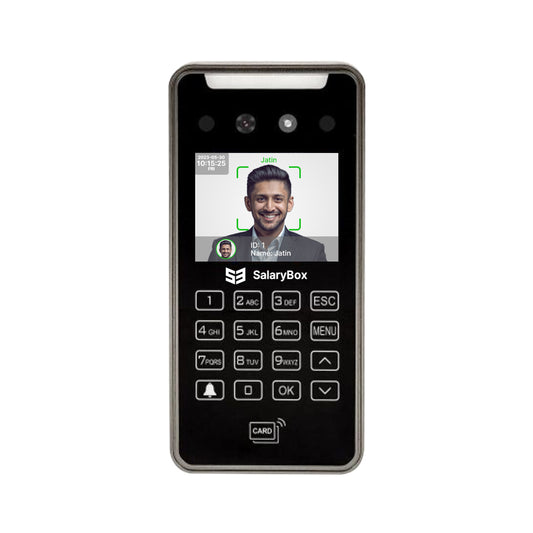
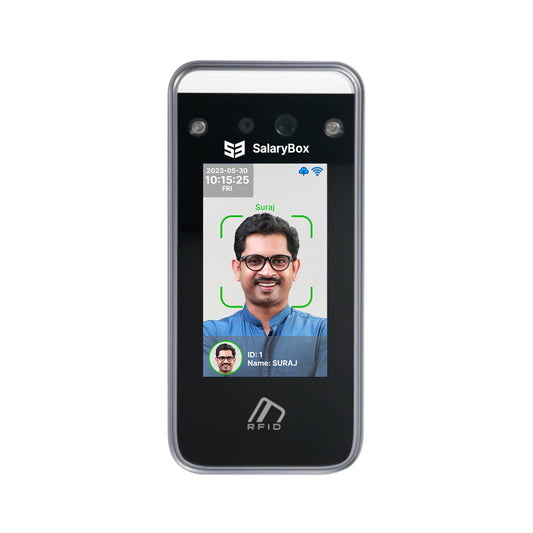
SalaryBox Gamma: An AI facial recognition biometric attendance machine with touchscreen, Wi-Fi/LAN connectivity, up to 1,000–10,000 user capacity, and massive transaction storage. Features AI-driven liveness detection, offline mode, and seamless payroll software integration. Priced around ₹13,999–₹18,000, it's perfect for corporate offices, manufacturing, and construction with its reliability and anti-tampering design.
-
SalaryBox Face Scan Pro: A more affordable face scan pro device at around ₹9,990, supporting up to 5,000 faces, HD cameras for varying lighting, mask detection, and inbuilt Wi-Fi. Ideal for small businesses, educational institutions, and retail needing hygienic solutions and visitor access management.
Both integrate with SalaryBox's cloud-based app for real-time attendance tracking, leave and attendance management, customized reporting, analytics, and HR software compatibility. They support mobile workforce with geofencing and ensure data privacy via secure storage.
SalaryBox devices provide excellent return on investment (ROI) through reduced maintenance costs, time fraud prevention, and automated workflows. With strong vendor support and manufacturer support, they're top choices for affordable biometrics in India.
Factors to Consider When Choosing a Biometric System
-
Security needs: Sensitive data? Opt for advanced encryption and security measures.
-
Team size and type: Small office? Fingerprint. Hybrid/remote? Facial.
-
Industry: Dusty sites? Avoid fingerprints. Hygiene-critical? Facial.
-
Budget: Include software licensing, implementation costs, network requirements.
-
User experience: Ease of integration, reporting capabilities, data management.
-
Compliance: Labour laws, privacy laws.
For most modern teams, facial recognition offers superior enhanced security, streamlined processes, and transparency.
Conclusion: Facial Recognition for the Win in Most Scenarios
While fingerprint recognition remains reliable and cost-effective for specific use cases, facial recognition emerges as the superior choice for its contactless, hygienic, and versatile nature. It addresses hygiene compliance, supports remote teams, and integrates AI for unmatched accuracy and fraud prevention.
Devices like SalaryBox Gamma and Face Scan Pro exemplify the best in AI-powered biometric technology, making them ideal for Indian businesses seeking operational efficiency and accurate payroll.
Investing in the right biometric attendance system boosts productivity, fosters accountability, and ensures regulation compliance, paving the way for growth.
FAQs
1. What is the difference between fingerprint and facial recognition in biometric attendance systems?
Fingerprint requires touch for scanning ridges, while facial uses AI to analyze features contactlessly—making facial more hygienic and faster.
2. Which is more accurate: fingerprint or facial recognition?
Both are highly accurate, but facial with AI liveness detection often has lower error rates in real-world conditions, especially with variations like masks or lighting.
3. Are facial recognition systems hygienic?
Yes, they are fully contactless, eliminating germ spread—perfect for post-pandemic workplaces and hygiene-focused industries.
4. How do biometric systems prevent proxy attendance and buddy punching?
By using unique biological traits that can't be shared, ensuring only the enrolled person can mark attendance.
5. What is the cost of biometric attendance machines in India?
Entry-level around ₹5,000–₹10,000, mid-range ₹10,000–₹15,000, high-end ₹15,000+—with facial models like SalaryBox Face Scan Pro starting at ₹9,990.
6. Which biometric device is best for small businesses?
Affordable facial options like SalaryBox Face Scan Pro offer great value with cloud integration and easy setup.
7. Can these systems integrate with payroll software?
Yes, advanced ones like SalaryBox seamlessly integrate for automated overtime, leaves, and salary calculations.
8. Is facial recognition secure against spoofing?
Modern devices use AI liveness detection to distinguish real faces from photos/videos.
9. Which is better for construction sites or dusty environments?
Facial recognition, as it avoids sensor issues from dirt or gloves common in fingerprint systems.
10. Why choose SalaryBox Gamma or Face Scan Pro?
They combine AI accuracy, cloud app, Wi-Fi connectivity, large capacity, and seamless payroll/HR integration, making them the best option for reliable, hygienic, and scalable attendance management in India.