
In today's fast-evolving digital ecosystem, biometric solutions have become essential for robust security, authentication, and access control. Multimodal biometric devices, which combine multiple biometric modalities like face recognition, fingerprint recognition, and iris scanning, offer multi-layered security that far surpasses unimodal systems. By fusing data from face features, fingerprints, and iris patterns, these devices minimize risks from spoof attacks, deep fakes, and intra-class variations, making them ideal for high-security applications.
The global biometric market is experiencing explosive growth, projected to reach USD 95.14 billion by 2030 with a CAGR of 12.3%. The rise in contactless biometrics post-COVID-19, coupled with advancements in AI integration, machine learning, and cloud-based solutions, has accelerated adoption. Multimodal systems address limitations of unimodal biometrics, such as non-universality, noisy data, or vulnerability to presentation attacks, through techniques like feature level fusion (FLF), score level fusion, and decision level fusion.
These devices excel in identification and verification across sectors like offices, airports, banks, gyms, hospitals, travel & immigration, government agencies, educational institutes, schools, and colleges. They support workforce management, attendance tracking, punch in times, visitor tracking, and profile management with features like advanced encryption, liveness detection, anti-spoofing, and seamless integration with RF cards or smart card authentication.
Multimodal biometrics leverage complementary strengths: fingerprints for detailed minutiae extraction, face recognition for contactless convenience, and iris scanners for unmatched distinctiveness. Processes involve image acquisition, feature extraction, processing & storage, and matching & authentication using algorithms enhanced by artificial intelligence and deep learning. This fusion reduces false acceptance ratio (FAR), false rejection ratio (FRR), and error rates while improving accuracy, precision, recall, and overall robustness.
Challenges like sensor malfunction, network connectivity issues, or slow authentication in poor conditions are mitigated through quarterly maintenance checks, AI-powered enhancements, and cloud computing. In healthcare, banking, and financial services, they enable secure financial transactions, Know Your Customer (KYC), Anti-Money Laundering (AML) compliance, and remote onboarding. At airports, they power e-gates, boarding passes, and biometric-enabled travel solutions.
As threats from cyberattacks and deep fakes grow, multimodal systems provide the ultimate defense, combining physiological and behavioral characteristics for superior identity management.
Why Multimodal Biometrics Offer Maximum Security
Unimodal biometric systems rely on a single trait, making them susceptible to spoofing, environmental factors, or intra-class variations. Multimodal biometric systems overcome these by integrating multiple traits, offering:
-
Higher Accuracy and Lower Error Rates: Fusion techniques (sensor, feature, score, or decision level) leverage complementary data, reducing false positives (FP), false negatives (FN), and improving metrics like G-mean, sensitivity, and specificity.
-
Resistance to Spoof Attacks: Liveness detection and AI combat presentation attacks, deep fakes, and masks.
-
Scalability and Integration: Cloud-based solutions support large databases, real-time monitoring, and API integration.
-
Contactless Options: Post-pandemic shift to face and iris for hygiene in healthcare and public spaces.
-
Regulatory Compliance: Advanced encryption (e.g., AES) ensures data privacy amid growing cybersecurity concerns.
Now, let's explore the 7 best multimodal biometric devices supporting face, fingerprint, and iris for maximum security in 2025.
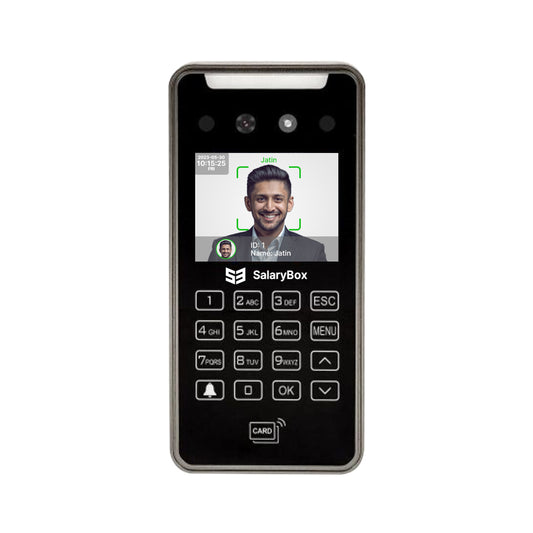
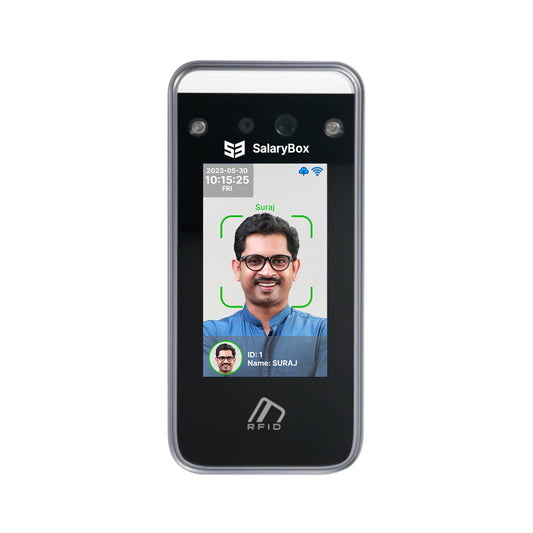
1. SalaryBox Gamma (Face + Fingerprint + Iris Integration)
SalaryBox leads the pack with its innovative multimodal biometric devices tailored for Indian businesses, combining face readers, fingerprint devices, and optional iris scanners through seamless hardware-software integration. Designed for attendance tracker needs in offices, factories, and hybrid teams, it offers AI-powered facial ID, fingerprint verification, and iris support for ultra-secure environments.
Pros:
-
Exceptional seamless integration with cloud-based payroll and HRMS, enabling real-time punch in times and workforce management.
-
Affordable scalability for SMEs, with advanced encryption and liveness detection to prevent fraud.
-
User-friendly mobile app for remote monitoring, ideal for field staff and multi-location operations.
-
High accuracy in varied lighting, with AI adapting to cosmetics, masks, or aging.
-
Comprehensive support including maintenance services, ensuring minimal downtime.
Cons:
-
Primarily optimized for business attendance and access control; for ultra-large-scale government deployments, additional custom modules may enhance capacity (though this allows tailored flexibility).
2. NEC NeoFace Multimodal System
NEC Corporation's NeoFace series excels in facial recognition fused with fingerprint recognition and iris recognition, widely used in law enforcement, airport security, and national ID programs.
Pros:
-
Top-ranked in NIST benchmarks for accuracy, with walk-through authentication capabilities.
-
Robust multimodal fusion for high-volume identification from massive databases.
-
Strong anti-spoofing and AI integration for real-world conditions like motion blur or glasses.
-
Versatile for border control, passports, and public safety.
Cons:
-
Higher cost suited for enterprise/government scale.
-
Requires professional installation for optimal performance.
3. Thales Cogent Multimodal ABIS
Thales Group's Cogent ABIS (Automated Biometric Identification System) integrates face, fingerprint, and iris for border control, fraud detection, and secure transactions.
Pros:
-
Excellent for large-scale deployments with high-speed matching.
-
Advanced data encryption and compliance with global standards.
-
Supports multimodal authentication in financial and immigration sectors.
-
Proven reliability in e-passports and ID cards.
Cons:
-
Complex setup may need specialized training.
-
Premium pricing for full multimodal features.
4. IDEMIA Multimodal Authentication Platforms
IDEMIA offers cutting-edge multimodal authentication combining face, fingerprint, and iris, ideal for passports, ID cards, and financial transactions.
Pros:
-
AI-driven algorithms ranking high in accuracy tests.
-
Seamless for digital wallets, remote onboarding, and cross-border payments.
-
Strong focus on privacy with encrypted biometric templates.
-
Versatile across banking, government, and travel.
Cons:
-
Integration with legacy systems can require custom development.
-
Higher initial investment for comprehensive setups.
5. Suprema BioStar 2 Multimodal Devices
Suprema Inc.'s BioStar 2 is a cloud-based biometric authentication platform supporting face, fingerprint, and iris in access control terminals.
Pros:
-
Flexible scalability with API integration and anti-spoofing.
-
Contactless options boosted post-pandemic.
-
Excellent for offices, educational institutes, and visitor tracking.
-
Durable hardware with real-time monitoring.
Cons:
-
Cloud dependency may pose issues in low-connectivity areas.
-
Advanced features locked behind subscriptions.
6. Innovatrics Multimodal SDK-Integrated Devices
Innovatrics provides SDKs for OEMs to build devices combining face, fingerprint, iris, and palm, with top NIST-ranked algorithms.
Pros:
-
Highly customizable for specific needs like access control or mobile enrollment.
-
Superior liveness detection and accuracy in challenging conditions.
-
Supports enterprise security, stadiums, and integrated systems.
-
Fast processing with low error rates.
Cons:
-
Primarily SDK-based, requiring development for full devices.
-
Best for manufacturers rather than off-the-shelf buyers.
7. GripID Mannix Portable Multimodal Scanner
GripID's Mannix is a compact, portable device with full-palm fingerprint, iris, and facial recognition, targeted at law enforcement and border security.
Pros:
-
Ultra-portable with rugged design for field use.
-
High-precision multimodal capture in one device.
-
FBI-certified sensors for reliable identification.
-
Ideal for mobile verification and immigration.
Cons:
-
Battery life limits extended fieldwork.
-
Specialized for professional/security use, less for daily office attendance.
Conclusion
Choosing the right multimodal biometric device depends on your needs, whether attendance tracker in offices, secure access control in banks, or high-stakes verification in airports and government agencies. These top 7 options provide multi-layered security through fusion of face, fingerprint, and iris, leveraging AI, encryption, and cloud solutions for future-proof protection.
The biometric market's rapid growth underscores the shift to multimodal systems for combating evolving threats like deep fakes and cyberattacks.
FAQs
1. What is multimodal biometrics?
Multimodal biometrics combine multiple traits (e.g., face, fingerprint, iris) for enhanced accuracy and security over unimodal systems Like Salarybox Gamma Biometric.
2. Why choose face + fingerprint + iris devices?
This combination offers maximum resistance to spoofing, high distinctiveness, and adaptability to conditions like poor lighting or dirty fingers.
3. Are these devices contactless?
Many support contactless face and iris scanning (like Salarybox Gamma), ideal post-COVID for hygiene in hospitals and public spaces.
4. How secure is biometric data storage?
Reputable systems use advanced encryption (e.g., AES), store templates (not raw images), and comply with privacy regulations.
5. Can these integrate with existing systems?
Yes, most offer seamless integration via APIs, cloud platforms, and support for RF/smart cards for eg. Salarybox Gamma Biometric.
6. What is the future of multimodal biometrics?
Growth in AI, cloud computing, and applications like biometric payment cards, digital wallets, and air travel solutions.
7. How do multimodal systems handle errors?
Through fusion algorithms, liveness detection, and maintenance, minimizing FAR/FRR while improving overall accuracy.